We travel to see life. We go to experience the vibrant pulse of a new city, to taste its food, and to hear the cacophony of its streets. But sometimes, the most powerful journeys are those that take us not into the heart of life, but to the quiet, profound edge of it. There is no place on Earth where this is truer than Pompeii.
To walk its stone streets is not simply to tour an archaeological site; it is to engage in a form of time travel so intimate it borders on the sacred. This isn’t a city of ruins. It is a city paused. A city holding its final, petrified breath.
Most blogs will give you a history: Mount Vesuvius erupted on August 24th, 79 AD. A plume of ash, pumice, and deadly gas buried the city under millions of tons of volcanic material. True, but sterile. It’s the human scale that undoes you. The experience isn’t in the date; it’s in the quiet moments of connection across two millennia.
The Echo in the Cobblestones
Your first surprise is the sheer normalcy. This was not some mythical lost kingdom; it was a thriving, bustling, and sometimes vulgar port town. The main streets are grooved by the precise, parallel ruts of countless chariot wheels, the Roman equivalent of tire tracks on a muddy road. You can’t help but place your foot inside one, a perfect fit, and feel the ghost of a cart jostle past.
You see the stepping stones at every intersection, allowing citizens to cross the street without stepping into… well, the less savory aspects of ancient street life. Children played here. Lovers met here. Shopkeepers hawked their fish and wine. The engineering is brilliant, but the humanity is breathtaking.
The Graffiti of the Ancients
Look closer. The walls are not blank. Scratched into the plaster are election notices: “I ask you to elect Gaius Pupius as duumvir, a man worthy of public office.” The ancient version of a campaign poster. Then there are the more personal declarations: “Lucilius was here,” or the cheeky “Samius to Cornelius: go hang yourself!”
This is the true voice of Pompeii. It’s not the grandiloquent prose of senators or historians. It’s the casual, everyday chatter of people entirely unaware they are speaking directly to the future. Their boasts, their insults, their political squabbles—it’s all there. The Romans, in their humanity, become startlingly familiar. They weren’t statues; they were us.
The Silence of the Gardens
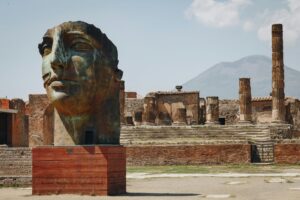
Stepping into a domus, a wealthy family’s home, is to understand Roman private life. The atrium, open to the sky, catches rainwater in an impluvium. The rooms are arranged around this central heart, quiet and cool. You can stand in the lush, replanted garden of the House of the Faun and hear nothing but the buzz of a bee and the whisper of the wind, the same sounds that would have filled the space before the world ended.
In the bakery, you find the petrified mills and the carbonized loaves of bread, still in their oven, forever uneaten. In the thermopolium, the Roman tavern, you see the beautiful terracotta jars (dolia) sunk into the counter, ready to serve hot wine and stew to hungry workers. The paint is still bright, the murals fresh. The absence of the people who should be here is a presence in itself.
Meeting Their Gaze
This is the moment your visit becomes personal. This is where you meet them. The casts.
No amount of reading can prepare you for this encounter. They are not bones. They are voids given form. When the ash and pumice hardened, it encased the victims, their bodies decomposing over centuries within the solid shell, leaving a perfect cavity.
Archaeologists, with a stroke of genius, began pouring plaster into these cavities in the 19th century. What emerged were the precise forms of Pompeii’s final moments. A man curled in a futile attempt to shield himself. A group of huddled souls, their terror immortalized. Most haunting of all is the cast often called “The Child.” It is a small, agonizing form, curled in what can only be described as an eternal sleep.
These are not artifacts. They are death masks of an entire city. They force you to stop. To breathe. To comprehend the individual tragedy within the colossal disaster. You are not looking at a statistic; you are witnessing a person’s last second on earth.
A Lesson in Fragility
We leave Pompeii quietly. The Italian sun is warm on your skin; the view of Vesuvius across the bay is deceptively serene, a gentle giant cloaked in green. The lesson of Pompeii is not that nature is cruel. It’s that civilization is fragile. Life is breathtakingly, beautifully temporary.
Pompeii is a memento mori on a city-wide scale. It reminds us that the bread in our oven, the graffiti on our walls, the political arguments in our streets, and the love in our homes are what truly matter. These are the things that, against all odds, can echo through centuries.
The cold froze the city in its final breath. But in that silence, it speaks louder than any living city ever could. It tells us to live, truly live, while we can.
Feeling inspired to walk through history yourself? Explore more unforgettable destinations and plan your next journey right here on ReachTV.