
From Matcha to Wellness Shots: The New Airport Lifestyle
Explore the airport wellness trend. From matcha to wellness shots, see how healthy drinks and cafés are changing airport travel culture.
Read more
In 1959, the Xin’an River hydroelectric dam project deliberately sacrificed the sunken city of Shi Cheng, also known as Lion City. Resting under a man-made lake, the freshwater environment astonishingly preserved Shi Cheng. At ReachTV, we believe the best adventures are often found off the beaten path—and sometimes, far beneath the surface. For every famous ancient city that still stands on dry land, there are countless others sleeping silently under the waves, their secrets whispered only to the currents.
These are the silent cities—lost worlds frozen in time, offering a humbling glimpse into human history swallowed by the sea. They are not just archaeological sites; they are portals to another era, where nature has become the ultimate guardian of memory. So, grab your fins and your sense of wonder as we dive into the world’s most mesmerizing underwater ruins.
Why do cities end up beneath the waves? The answers are as varied as the civilizations themselves. Some were consumed by sudden natural disasters—earthquakes, volcanic eruptions, and tsunamis. Others slowly surrendered to rising seas over millennia. And in modern times, some were intentionally flooded to create reservoirs or hydroelectric dams.
Regardless of the cause, what remains is an aquatic time capsule. Underwater, decay slows. Structures, artifacts, and even entire street plans are preserved in ways dry land could never allow. Exploring these sites isn’t just diving—it’s stepping into history, suspended in silence.
Each of these underwater ruins carries its own story, from pirate strongholds to mysterious monuments.
In the 17th century, Port Royal was infamous as the “wickedest city on Earth.” Pirates, privateers, and merchants turned it into a raucous hub of wealth and vice. That all ended on June 7, 1692, when a massive earthquake struck, sending two-thirds of the city sliding into the Caribbean Sea.
The Experience: Today, divers can swim through preserved streets and foundations, spotting cannons, pottery, and even a clock that stopped at exactly 11:43 AM—the moment the city was swallowed.
Why It’s Unique: Few sites in the world feel as eerie and cinematic. Diving here is like entering a pirate legend, now ruled by coral and tropical fish.
Just off the coast of Laconia, Greece, lies Pavlopetri, a city that dates back more than 5,000 years. Discovered in 1967, it is the oldest known submerged city anywhere on Earth.
The Experience: Pavlopetri is shallow enough for snorkelers to explore. The site includes a preserved street grid, homes, courtyards, and tombs. Archaeologists believe it was once a Bronze Age trading hub. Swimming over its perfectly preserved plan feels like hovering above a blueprint from antiquity.
Why It’s Unique: Unlike scattered ruins, Pavlopetri is remarkably intact. It offers one of the rare chances to explore a complete ancient city that has been protected by sand and sea for millennia.
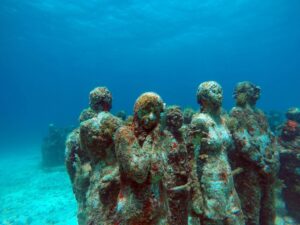
In 1959, the Xin’an River hydroelectric dam project deliberately sacrificed the sunken city of Shi Cheng, also known as Lion City. Resting under a man-made lake, the freshwater environment astonishingly preserved Shi Cheng. Divers can explore intricate stone carvings, archways, and staircases as if the city were waiting for its people to return.
Why It’s Unique: The city feels less like ruins and more like a ghostly metropolis preserved in perfect stillness. Its story blends human progress with historical loss, making it both haunting and beautiful.
Off Yonaguni Island in Japan lies one of the ocean’s great enigmas: the Yonaguni Monument. Massive, tiered stone formations rise from the seabed, complete with sharp angles, flat terraces, and what look like stairways.
The Experience: Diving here feels like exploring a colossal temple. Whether natural or man-made, its scale is breathtaking. The mystery surrounding its origins—ancient civilization or natural geology—only adds to its intrigue.
Why It’s Unique: More than ruins, this site is an underwater puzzle. Each diver becomes part of the debate, forming their own conclusion while navigating its silent corridors.
Dreaming of exploring these underwater time capsules? Here are key tips:
Exploring a silent city is more than an adventure—it’s a humbling reminder of how fragile human achievements can be. These submerged ruins connect us to civilizations that once thrived, to stories interrupted by disaster or progress, and to the ocean’s quiet power as a keeper of history.
At ReachTV, we believe travel is about more than movement—it’s about discovery. And sometimes, the most powerful discoveries are found not on land, but in the deep silence of the sea.
Explore the airport wellness trend. From matcha to wellness shots, see how healthy drinks and cafés are changing airport travel culture.
Read more
Discover set-jetting destinations travelers visit after Netflix and HBO shows. Explore filming locations that turn TV moments into trips.
Read more
Discover how airport automation improves travel with biometric boarding, AI systems, and faster check-ins.
Read more