Beyond the Postcard: Experiencing the Real Machu Picchu
A City Lost, A Dream Preserved
Picture this: You’ve been hiking for three days, your lungs burning in the thin Andean air, your legs screaming protests with every stone step. Then suddenly, through a gap in the clouds, you see it. Not ruins. Not stones. But something alive, breathing, impossible. Your heart stops. This is Machu Picchu, and it’s nothing like you imagined.
Most people see photographs and think they know this place. They’re wrong. Standing here, 8,000 feet above the world, with condors circling overhead and mist swirling around granite walls that shouldn’t exist, you realize you’re witnessing something beyond archaeology. You’re seeing proof that humans once built dreams from stone.
The Spanish conquistadors ransacked every Inca city they could find, melting golden artifacts into coins and converting temples into churches. But they never found this place. For over 400 years, Machu Picchu kept its secrets, hidden in clouds, protected by peaks that pierce the sky like ancient spears. When Hiram Bingham stumbled upon it in 1911, following Quechua guides who’d never forgotten its location, he discovered something unprecedented: a lost civilization that chose to vanish rather than surrender.
Architectural Poetry in Stone
Emperor Pachacuti didn’t just build a city here in the 15th century. He created a sanctuary where earth touches heaven, where every sunrise becomes a ceremony, and where stones fit together so perfectly that they’ve survived centuries of earthquakes without mortar. This wasn’t random construction; this was architectural poetry written by master craftsmen who understood something we’ve forgotten about harmony between human ambition and natural forces.
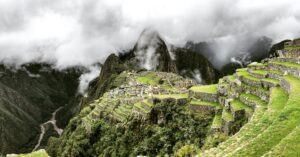
Walk through the Sun Gate at dawn, just as Inca nobility once did, and you’ll understand why this place captivates millions. The Temple of the Sun aligns perfectly with the winter solstice, bathing ancient rituals in golden light. Agricultural terraces cascade down impossible slopes like frozen waterfalls, demonstrating engineering that would challenge modern architects. The Intihuatana Stone, a mysterious granite sundial, continues tracking celestial movements with astronomical precision that rivals contemporary instruments.
More Than Ruins: A Sacred, Living Place
But here’s what no guidebook tells you: Machu Picchu doesn’t feel like ruins. It feels like a place temporarily paused, waiting for its inhabitants to return. Tourists instinctively lower their voices, sensing they’ve entered something sacred. Every carefully carved stone suggests intention beyond mere function. This city worshipped both earth and sky, creating architecture that grows from the mountain itself rather than conquering it.
The mystery endures beautifully. Scholars still debate whether Machu Picchu’s true purpose was a royal retreat, an astronomical observatory, a ceremonial center, or a fortress against invasion. Perhaps it was all of these, or something transcending our modern categories. This ambiguity transforms every visit into personal discovery, every photograph into an attempt to capture the ineffable.
Planning Your Journey to the Lost City
Getting here requires planning worthy of the destination. Daily visitor numbers are strictly limited to preserve this UNESCO World Heritage site’s delicate ecosystem, so advance booking is essential. Most journeys begin in Cusco, that remarkable city where Spanish colonial architecture sits atop Inca foundations like a visual metaphor for cultural collision. From there, choose your adventure: the legendary four-day Inca Trail trek that follows ancient pathways through cloud forests and mountain passes, or the scenic railway through the Sacred Valley, where Andean landscapes unfold like pages in an illuminated manuscript.
The Inca Trail offers something irreplaceable: arriving at Machu Picchu on foot, just as its original inhabitants did, after days of walking where they walked, sleeping under the stars they once navigated by, and feeling the physical and spiritual journey merge into transformation. Each bend reveals new vistas; each ancient stairway connects you directly to the civilization that carved this path centuries ago.
The Art of Slow Travel at Machu Picchu
But regardless of how you arrive, the key to experiencing Machu Picchu authentically is simple: slow down. This isn’t a monument to be quickly photographed and forgotten. Find a terrace, sit in silence, and watch fog drift across peaks that have witnessed empires rise and fall like seasonal weather. Listen to the profound quiet that makes every whisper seem sacred. Feel the thin air that makes your heart race, not just from the altitude, but from standing in a place that bridges our world with something greater.
What makes this place one of the New Seven Wonders isn’t just its architectural brilliance or mysterious history. It’s the way Machu Picchu changes you. Visitors leave carrying something indefinable, a sense of human possibility, a connection to civilizations that achieved the harmony we are still seeking, and proof that our ancestors could build dreams from granite and suspend them between earth and heaven.
A Timeless Message from the Clouds
In our age of instant answers and digital omniscience, Machu Picchu offers something increasingly rare: genuine mystery that enhances rather than diminishes wonder. Standing among those perfectly fitted stones, surrounded by peaks that dwarf human ambition while simultaneously showcasing its greatest triumph, you understand why this place captures hearts across cultures and centuries.
Machu Picchu isn’t just Peru’s crown jewel or South America’s must-see destination. It’s humanity’s love letter to possibility itself, carved in stone and hidden in clouds until the world was ready to receive its message. Some places you visit. Others visit you back, leaving their mark on your soul long after you’ve returned home. Machu Picchu is definitely the latter.
Ready to experience the magic that photographs can’t capture? Start planning your journey to the city that refused to disappear. Because some dreams are worth climbing mountains for, literally.
Discover more transformative travel experiences and hidden wonders around the globe. Follow ReachTV on Instagram for stories that turn ordinary trips into extraordinary adventures.